
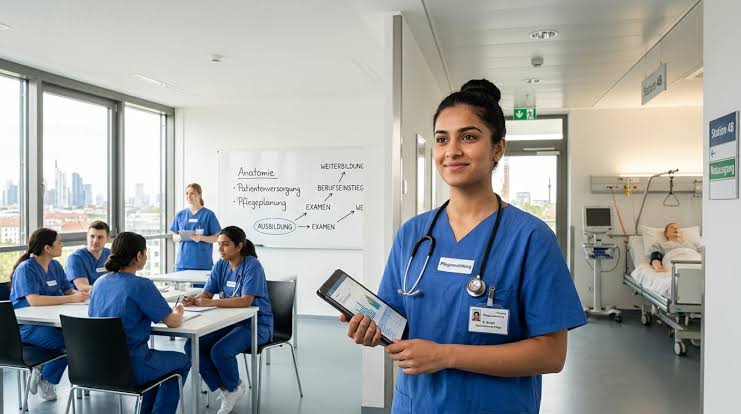
Nursing is one of the most important healthcare professions in Germany, with opportunities in hospitals, elderly care facilities, outpatient services, rehabilitation centers and other healthcare settings. For international students and healthcare professionals, Nursing in Germany can provide both an educational pathway and a long-term career opportunity.
Germany offers several routes into nursing, including vocational training and, depending on the university and programme, academic study in nursing-related fields. For international applicants, however, understanding the difference between studying nursing and working as a qualified nurse is essential. Language skills, educational qualifications, professional recognition and immigration requirements can all affect the available pathway.
For foreign-trained nurses, Germany also has specific recognition procedures because nursing is a regulated profession. This means that simply having a nursing degree or diploma from another country is generally not enough to work independently as a professional nurse in Germany. The qualification must be recognised and the applicant must meet additional requirements, including German-language and health requirements.
Nursing Education in Germany: How Does It Work?
One of the main routes into Nursing in Germany is vocational training to become a Pflegefachfrau, Pflegefachmann or Pflegefachperson. This training combines theoretical education with practical experience and prepares students to care for patients across different healthcare environments.
The general nursing programme includes training in areas such as patient care, medical procedures, prevention, nursing documentation and the organisation of nursing processes. Students gain experience working with people of different ages and in different healthcare settings.
The programme is particularly attractive to international applicants because it combines education with practical professional experience. Rather than completing only classroom-based study, trainees spend part of their education in practical healthcare environments.
During the first two years, students receive general nursing training. Before the final year, there may be opportunities to specialise in areas such as elderly care or paediatric nursing, or to continue with the generalist nursing qualification.
Main Study and Training Routes for International Applicants
International applicants should first decide whether they want to enter Germany as a nursing student or as an already qualified foreign nurse.
| Pathway | Suitable for | Main Requirement |
|---|---|---|
| Nursing vocational training | Students without a German nursing qualification | School qualification, German language and training place |
| Nursing-related university study | Applicants seeking an academic route | University entrance qualification and programme-specific requirements |
| Recognition of foreign nursing qualification | Qualified nurses from abroad | Recognition of professional qualification |
| Adaptation programme | Nurses whose qualifications have substantial differences | Adaptation training or knowledge assessment |
| Nursing assistant pathway | Applicants who do not yet qualify as professional nurses | Relevant training and state-specific requirements |
The correct pathway depends heavily on the applicant’s previous education and professional experience. A person who already has several years of nursing experience should not automatically start a new full vocational programme without first checking whether their existing qualification can be recognised.
Requirements to Study Nursing in Germany
Applicants interested in nursing vocational training generally need an intermediate school-leaving certificate or an equivalent educational qualification. Requirements can vary according to the federal state and training provider.
German language proficiency is another major requirement. Official German information indicates that nursing trainees may need German at B1 or B2 depending on the federal state and the specific training arrangement.
Applicants are also generally expected to demonstrate physical and mental fitness for the profession and provide evidence of personal reliability, such as a criminal-record certificate.
For university-level study, requirements are different. Applicants normally need a university entrance qualification, and the exact admission conditions depend on the institution and programme. International educational qualifications may need to be assessed to determine whether they provide access to higher education in Germany.
German Language Requirements for Nursing
Language is particularly important in Nursing in Germany because nurses communicate directly with patients, doctors, relatives and other healthcare professionals.
For vocational training, B1 or B2 German may be required depending on the state and programme. For foreign-qualified nurses seeking professional recognition and a licence to practise, B2 German is generally required.
The importance of German goes beyond passing a language exam. Nurses need to understand medical terminology, communicate instructions, document patient information and respond appropriately to emergencies.
For this reason, applicants planning Study Immigration should ideally begin German-language preparation before arriving in Germany. Reaching a higher level can make both training and daily clinical communication considerably easier.

Recognition of Foreign Nursing Qualifications
Foreign-trained nurses face a different process from people entering nursing education for the first time.
Nursing is a regulated profession in Germany. A foreign nursing qualification must therefore generally be recognised before the applicant can work as a qualified nurse and use the corresponding professional title.
During the recognition process, the competent German authority compares the foreign qualification with the German reference profession, Pflegefachfrau/Pflegefachmann or Pflegefachperson.
There are generally two main possibilities. The authority may assess the qualification for equivalence, or the applicant may choose an adaptation route where applicable. If substantial differences are identified, the applicant may need to complete an adaptation period or pass a knowledge assessment.
The application is submitted to the competent authority in the German federal state where the applicant intends to work. Recognition granted through the relevant procedure is generally valid throughout Germany.
Documents Needed for Nursing Recognition
The exact document list can vary according to the applicant and the responsible authority, but international nurses should generally prepare a comprehensive professional file.
| Document | Purpose |
|---|---|
| Passport | Identity verification |
| Nursing diploma or certificate | Evidence of professional qualification |
| Academic transcripts | Details of education and training |
| Training syllabus | Helps authorities assess equivalence |
| Employment certificates | Evidence of professional experience |
| Professional licence, if applicable | Evidence of authorisation in the home country |
| German language certificate | Demonstrates required language proficiency |
| Medical certificate | Evidence of physical and mental fitness |
| Criminal-record certificate | Evidence of personal reliability |
| Certified translations | Allows German authorities to evaluate documents |
Professional experience can also be taken into account during the recognition procedure, alongside the content and duration of the applicant’s education.
Nursing Career Opportunities in Germany
Once qualified and properly authorised, nurses can work in a wide variety of healthcare environments.
Hospitals are one of the largest employment areas, but they are not the only option. Nursing professionals can also work in residential care, outpatient nursing services, rehabilitation facilities and specialised healthcare institutions.
Possible career areas include:
- General hospital nursing
- Elderly and long-term care
- Paediatric nursing
- Outpatient nursing
- Rehabilitation
- Intensive care
- Surgical nursing
- Geriatric care
- Psychiatric nursing
- Occupational health
- Nursing management
The general nursing qualification also provides a foundation for further professional development. Nurses can pursue additional training and specialise in particular areas of healthcare.
Nursing Salaries and Financial Prospects
Income in nursing depends on factors such as qualification, professional experience, employer, location, collective agreements and specialisation. Hospitals and other institutions operating under collective agreements may have structured salary scales.
Applicants should distinguish between the income received during vocational training and the salary of a qualified nursing professional. Training compensation is determined by the training provider, region and applicable collective agreement. The Federal Employment Agency notes that training remuneration varies according to profession, region and whether the employer is covered by a collective agreement.
After qualification, experienced nurses can improve their earning potential through professional experience, specialised training and positions involving greater responsibility.
For international applicants, Germany’s nursing sector can therefore provide a relatively clear career progression from vocational training or recognition to specialised clinical positions and management roles.
Working as a Nurse After Graduation
Completing nursing training does not mean that every international applicant can automatically begin working in any healthcare position. The professional qualification, authorisation and residence status must all be considered.
Graduates of a German nursing programme can move into professional employment after successfully completing their training and meeting the relevant conditions.
International nurses whose qualifications were obtained abroad need to complete the appropriate recognition process. They must also meet requirements related to German language proficiency, medical fitness and personal reliability.
This makes nursing different from many non-regulated occupations in Germany. Applicants should therefore plan the recognition process early rather than waiting until they have already secured employment.
Nursing Work Opportunities for International Professionals
Germany actively recruits healthcare professionals from abroad, and nursing is specifically identified as an important occupation for international recruitment.
Third-country nurses generally need individual recognition of their professional qualifications. If differences are found between their education and the German reference qualification, an adaptation programme may be required.
There are also immigration pathways that can support qualified healthcare professionals, including routes connected to recognition procedures and skilled employment. Under certain conditions, international professionals can use a recognition partnership with an employer to enter Germany and complete recognition-related procedures while working within the applicable legal framework.
The right immigration route depends on the applicant’s qualification, employment situation and recognition status.
Visa Options for Nursing in Germany
Non-EU applicants generally need an appropriate visa or residence permit to study, train or work in Germany.
Someone entering Germany for nursing vocational training may require a residence permit for vocational training under Section 16a of the German Residence Act. The official German immigration information confirms that third-country nationals require a visa or residence permit for vocational training.
Qualified foreign nurses who already have a recognised professional qualification may instead use an employment-based immigration route.
Depending on the individual situation, other pathways may also be relevant, including recognition-related residence permits or the Opportunity Card for eligible applicants seeking employment in Germany.
Because nursing is regulated, applicants should coordinate the professional recognition process with their Visa Application rather than treating immigration and professional licensing as completely separate processes.
Can Nursing Lead to Permanent Career Development?
Yes. Nursing can offer several opportunities for long-term professional development in Germany.
After gaining experience, nurses can specialise in clinical areas or move into positions with greater responsibility. Further education can lead toward nursing management, specialised clinical roles, education or other healthcare-related positions.
Professional development is especially valuable in areas where healthcare providers require specialised knowledge. Nurses can also improve their career prospects by developing German language skills and gaining experience with digital healthcare systems and documentation.
For international professionals planning Work Immigration, this makes nursing more than an entry-level occupation. It can serve as the starting point for a longer professional career in the German healthcare system.
Advantages and Challenges of Nursing in Germany
Nursing in Germany offers several important advantages for international applicants. Germany has a large healthcare sector, a structured professional education system and multiple employment environments for qualified nurses.
At the same time, applicants should be prepared for challenges. German is essential for effective patient communication, professional recognition can take time, and nursing is physically and emotionally demanding.
| Advantages | Challenges |
|---|---|
| Strong healthcare sector | High German-language requirements |
| Multiple employment settings | Recognition for foreign nurses |
| Clear professional training pathways | Physically demanding work |
| Opportunities for specialisation | Administrative requirements |
| Long-term career development | Adapting to German healthcare procedures |
| Opportunities for international professionals | Professional communication in German |
Understanding these factors before applying can help international applicants make a more realistic decision about their future.
Is Nursing in Germany a Good Option for International Students?
For students who are genuinely interested in healthcare and patient care, Germany can be an attractive destination. The vocational training route combines theory and practical experience and can provide a direct transition into the German labour market after qualification.
However, nursing should not be selected simply because it is considered a high-demand occupation. Applicants need strong communication skills, emotional resilience, interest in healthcare and a willingness to work in a demanding professional environment.
German-language preparation should also begin as early as possible. The ability to communicate confidently with patients and colleagues can have a major impact on both academic progress and professional success.
For applicants who already have a nursing qualification from another country, a recognition assessment should be considered before deciding to repeat an entire nursing programme in Germany.

How Homa Immigration Institute Can Help
Planning Nursing in Germany involves more than choosing a programme or finding a healthcare employer. International applicants may need to evaluate their previous education, prepare translated documents, meet German-language requirements, complete professional recognition and select the appropriate immigration route.
Homa Immigration Institute can help applicants assess whether vocational training, university study or recognition of an existing nursing qualification is the most appropriate pathway. The institute can also provide guidance on documentation, Study Immigration, Work Immigration and the relevant Visa Application process.
For applicants with an existing nursing qualification, an early assessment of professional recognition can be particularly important because nursing is a regulated profession in Germany.
Frequently Asked Questions About Nursing in Germany
Can international students study nursing in Germany?
Yes. International applicants can apply for nursing vocational training if they meet the educational, language and other requirements of the training provider and relevant German authorities.
What level of German is required for nursing?
Requirements vary by pathway and federal state. Nursing trainees may need B1 or B2 German, while foreign-qualified nurses seeking professional authorisation generally need B2 German.
Is nursing a regulated profession in Germany?
Yes. Nursing is a regulated profession. Foreign-qualified nurses generally need recognition of their qualification and authorisation to practise before working as professional nurses in Germany.
Can a foreign nursing degree be recognised in Germany?
Yes. Foreign nursing qualifications can be assessed through the German recognition system. If substantial differences are identified, the applicant may need an adaptation programme or knowledge assessment.
Can nursing lead to permanent employment in Germany?
Yes. After completing the relevant training or obtaining recognition of a foreign qualification, nurses can pursue employment in hospitals, care facilities, outpatient services and other healthcare institutions, subject to the applicable professional and residence requirements.
Final Considerations
Nursing in Germany combines professional education, practical healthcare experience and strong long-term employment potential. International students can enter through vocational training or relevant academic programmes, while already-qualified nurses can explore professional recognition instead of starting their education from the beginning.
The most important preparation steps are learning German, evaluating educational qualifications, preparing professional documents and understanding the difference between nursing education and professional recognition.
For foreign applicants, careful planning is particularly important because nursing is a regulated profession. With the right qualification, language level, recognition strategy and immigration pathway, Germany can provide a strong environment for developing a long-term nursing career.
Sources
- Make it in Germany – Nursing Professional
- Make it in Germany – Nursing Professionals
- Make it in Germany – Nursing and Care Professionals from Abroad
- Recognition in Germany – General Nurse Recognition Procedure
- Recognition in Germany – Recognition Procedure
- Federal Employment Agency – Vocational Training in Germany


