
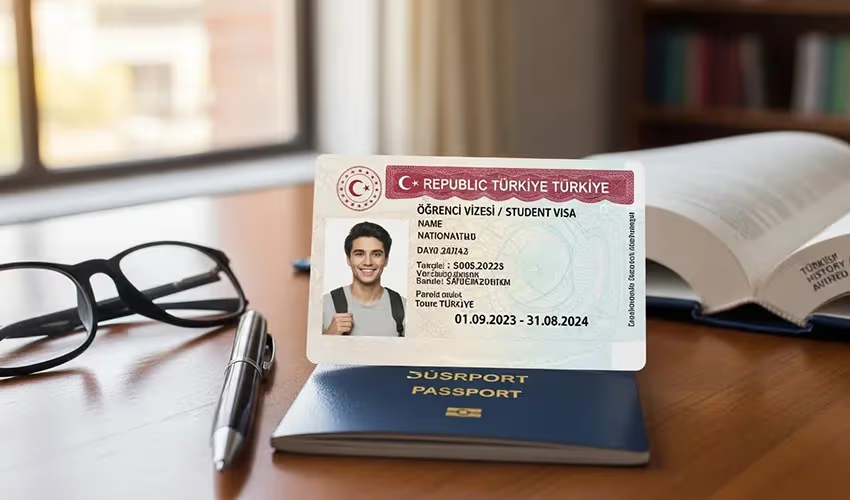
Pursuing a PhD in Türkiye can provide international students with access to established universities, research opportunities and a growing academic environment at the intersection of Europe and Asia. However, admission to a doctoral program is only one part of the process. International students must also understand the immigration requirements that allow them to enter and legally remain in Türkiye during their studies.
The Turkey Student Visa for PhD is particularly important for applicants who are subject to Türkiye’s visa requirements. The exact procedure can vary according to nationality, country of application, university and individual circumstances. Türkiye’s Ministry of Foreign Affairs classifies doctoral study under the student-education visa category, while some international students may enter under visa exemption arrangements and then complete their residence procedures in Türkiye.
For prospective PhD students, understanding the relationship between university admission, the student visa and the student residence permit is essential. This guide explains the main requirements, documents, application stages, financial considerations and residence procedures for international doctoral students planning to study in Türkiye in 2026.
What Is a Turkey Student Visa for PhD Students?
A Turkey Student Visa for PhD is an education-related entry visa used by eligible foreign nationals who intend to pursue doctoral-level studies in Türkiye. The Turkish Ministry of Foreign Affairs lists “Education Purpose” under the Student-Education Visa category. Study-related visa applications are handled differently from tourist or business visas.
One important point is that not every international PhD student will necessarily follow exactly the same visa route. Türkiye’s visa regime depends on nationality and the circumstances of the applicant. Some foreign nationals may be exempt from obtaining a visa for entry, while others must apply through a Turkish diplomatic mission before traveling.
The distinction between an entry visa and residence permission is therefore important. A student visa allows an eligible applicant to enter Türkiye for the stated educational purpose, while the student residence permit regulates the student’s longer-term legal stay.
For doctoral students, this distinction becomes especially relevant because a PhD normally lasts substantially longer than the period permitted under a standard short-term entry arrangement.
7 Essential Requirements for a Turkey Student Visa for PhD
Although individual consulates can request additional documentation, applicants should normally prepare a complete academic, identity and financial file before submitting their application.
| Requirement | Purpose |
|---|---|
| Valid passport | Establishes identity and travel eligibility |
| PhD admission or acceptance letter | Demonstrates the educational purpose of the trip |
| Student visa application | Provides the formal basis for the visa request |
| Biometric photographs | Required for identification |
| Proof of financial resources | Demonstrates the ability to cover study and living expenses |
| Health insurance or relevant coverage | Supports the applicant’s stay in Türkiye |
| Supporting academic documents | Confirms previous education and eligibility |
| Accommodation information | Helps demonstrate the planned place of stay |
| Additional consular documents | May be requested according to nationality or individual circumstances |
Applicants should not assume that a document accepted by one Turkish mission will automatically be sufficient at another mission. Consular authorities can request additional evidence depending on the applicant’s situation.
1. PhD Admission Letter
The first major document is the official acceptance or admission letter from the Turkish university.
Before starting the visa process, the applicant should have formal confirmation that they have been accepted into a doctoral program. The document should clearly identify the university, doctoral program and relevant academic details.
This document is particularly important because the student visa is based on the applicant’s educational purpose. A tourist visa or e-Visa should not be treated as a substitute for an education visa when the applicant is required to obtain a visa for study. Türkiye’s Ministry of Foreign Affairs explicitly distinguishes study visas from tourist and business visas.
2. Valid Passport
The passport should be valid for the required period and contain sufficient space for visa processing where applicable.
Türkiye’s Ministry of Foreign Affairs states that foreign nationals entering the country should generally have a travel document valid for at least 60 days beyond the duration of stay granted by the relevant visa, visa exemption or residence authorization.
Because doctoral studies can last several years, applicants should also consider the practical validity of their passport throughout the planned study period.
3. Proof of Financial Resources
Financial documentation is an important part of preparing for a Turkey Student Visa for PhD.
The purpose is to demonstrate that the applicant has realistic financial resources for expenses such as tuition, accommodation, food, transportation, insurance and other living costs.
There is not a single universal bank-balance figure that can be presented as an automatic requirement for every PhD applicant. Financial expectations can vary depending on the applicant’s circumstances, university, scholarship and the requirements of the relevant Turkish mission.
A strong financial file may include:
- Recent bank statements
- Scholarship confirmation
- Proof of tuition payment
- Sponsorship documents
- Sponsor’s bank statements
- Employment or income documents
- Evidence of accommodation arrangements
Applicants should avoid unexplained large deposits immediately before submitting their application. If a significant amount has recently been transferred into an account, supporting evidence explaining the source of the funds can make the financial file more understandable.
4. Health Insurance and Medical Coverage
Health coverage is another issue that international PhD students should consider before and after entering Türkiye.
The Turkish Ministry of Foreign Affairs states that visa applicants are required to have medical insurance valid during their stay in Türkiye.
The residence permit stage has its own rules. According to the Presidency of Migration Management, students can become covered by Türkiye’s general health insurance system under the applicable conditions. Students who request general health insurance within three months of enrollment may not need separate private insurance under the relevant student residence rules; otherwise, private health insurance can become necessary.
Because insurance requirements can change according to the student’s status, university enrollment and residence application, PhD students should verify the current requirements when preparing their residence file.
5. Biometric Photographs and Application Documents
Applicants should prepare recent biometric photographs that meet the specifications requested for their application.
Other documents may include:
- Completed visa application form
- Passport copy
- University admission letter
- Academic certificates
- Financial evidence
- Scholarship documents, if applicable
- Accommodation information
- Health insurance documentation
- Visa fee payment evidence
- Additional documents requested by the consular office
The exact checklist should be confirmed with the Turkish diplomatic mission responsible for the applicant’s place of residence.
6. Visa Application Through the Turkish Mission
For applicants who require a visa, the application is normally submitted through the appropriate Turkish diplomatic representation.
Türkiye’s Ministry of Foreign Affairs explains that applicants who are not exempt from an entry visa may use the Pre-Application System for Turkish Sticker Visa and may then be directed according to their circumstances and eligibility. For study purposes, applicants should follow the education-visa route rather than the tourist e-Visa route.
The Ministry also recommends applying sufficiently in advance because processing can take time. Its general guidance recommends applying at least one month before the planned travel date.
For a PhD applicant, waiting until the last few days before university registration can create unnecessary risk. A better approach is to begin preparing the visa file as soon as the admission process is finalized.
7. Student Residence Permit After Arrival
Obtaining a visa, when required, does not eliminate the need to understand residence procedures.
Foreign students enrolled in associate, undergraduate, graduate or postgraduate programs in Türkiye can qualify for a student residence permit if they meet the applicable conditions. The Presidency of Migration Management specifically includes graduate and postgraduate education among the categories covered by student residence permits.
After enrollment, students generally complete the relevant residence permit application through the e-Residence system and prepare the required documents. The official student residence application process explains that students must complete the application form and submit the required documents to the relevant university unit according to the university’s instructions.
The current 2026 student residence application form also lists documents such as the residence permit application form, passport copies, biometric photographs and proof of payment of the residence permit document fee.

Turkey Student Visa for PhD: Application Process Step by Step
The overall process can be organized into several stages.
Step 1: Choose a PhD Program
Start by identifying a doctoral program that matches your academic background and research interests.
International applicants should examine:
- University accreditation and recognition
- Language of instruction
- Research facilities
- Supervisor availability
- Tuition fees
- Scholarship opportunities
- Admission requirements
- Application deadlines
Türkiye’s Council of Higher Education provides international students with information about the country’s higher education system and directs prospective international students toward the Study in Türkiye platform for university and program information.
Step 2: Obtain University Admission
The university application generally comes before the visa application.
Depending on the institution and program, applicants may need academic transcripts, a master’s degree, language test results, a research proposal, recommendation letters, a CV and other academic documents.
PhD admission requirements are determined by individual universities and programs, so applicants should not assume that one university’s requirements apply to every doctoral program in Türkiye.
Step 3: Prepare the Visa File
Once admission is confirmed, prepare the documents required for the student visa.
At this stage, organize the documents into clear categories: identity, academic admission, financial resources, accommodation and insurance.
If you receive a scholarship, include the official scholarship confirmation because it can help explain how tuition and living expenses will be covered.
Step 4: Submit the Visa Application
Applicants who require a visa should follow the Turkish mission’s application procedure.
The application should accurately match the information contained in the university admission documents. Differences in names, program titles, dates or other important information can create delays or requests for clarification.
Step 5: Travel to Türkiye
After the visa is issued, the student can make travel arrangements according to the validity and conditions of the visa.
Applicants should carry important documents with them when traveling, including their passport, admission letter, accommodation information and relevant financial or scholarship documentation.
Step 6: Complete University Enrollment
After arrival, complete the university’s registration procedure.
This step is important because residence procedures depend on the student’s actual enrollment and documentation from the higher education institution.
Step 7: Apply for the Student Residence Permit
After completing the necessary university procedures, PhD students should follow the applicable student residence permit process.
The student residence permit can generally be issued for the period of study under the applicable rules. Türkiye’s immigration authority states that student residence permits cover foreigners studying in higher education, including graduate and postgraduate programs.
Can PhD Students Work in Türkiye?
A doctoral student may have opportunities to work in Türkiye, but studying does not automatically provide unrestricted employment rights.
According to the Presidency of Migration Management, graduate and doctoral students can work if they obtain a work permit.
This distinction is important for applicants considering both education and employment as part of their long-term plan.
A PhD student who receives a legitimate employment opportunity should therefore examine the relevant work permit requirements before starting employment. The rules for employment are separate from the student’s academic admission and student residence status.
For international students planning Study Immigration with a longer-term career objective, understanding the relationship between academic status and employment authorization can be an important part of planning.
What About PhD Scholarships in Türkiye?
Scholarships can significantly change the financial structure of a doctoral application.
A scholarship may cover all or part of tuition, accommodation, monthly living expenses or other academic costs, depending on the specific program.
Türkiye also has scholarship and academic support mechanisms associated with its higher education system. The Council of Higher Education lists several programs and support mechanisms for doctoral students and international researchers, although eligibility varies by program.
Applicants receiving funding should obtain an official document that clearly states the scholarship terms. This can be useful both for university procedures and for demonstrating how study-related expenses will be financed.
Common Mistakes When Applying for a Turkey Student Visa for PhD
Even a strong academic applicant can experience problems if the immigration file is incomplete or inconsistent.
One common mistake is applying for the wrong type of visa. An e-Visa is designed for eligible tourism or commerce purposes and should not be treated as a general student visa. Türkiye’s Ministry of Foreign Affairs clearly states that e-Visas are valid for tourism or commerce, while study purposes follow the appropriate visa route.
Another mistake is submitting financial documents without explaining the source of funds. Applicants should prepare a coherent financial story rather than simply presenting a bank balance.
Other frequent problems include:
- Using an expired or insufficiently valid passport
- Submitting an outdated admission letter
- Providing inconsistent information across documents
- Ignoring university registration deadlines
- Waiting too long to start the visa process
- Assuming that visa requirements are identical for every nationality
- Confusing the student visa with the student residence permit
- Failing to prepare documents requested by the relevant consulate
Turkey Student Visa for PhD: Visa vs. Residence Permit
The difference between these two immigration documents is worth emphasizing.
| Feature | Student Visa | Student Residence Permit |
|---|---|---|
| Main purpose | Entry to Türkiye for education | Legal residence during studies |
| Issuing authority | Turkish diplomatic representation, where required | Turkish immigration authorities |
| Main stage | Before travel | After enrollment/arrival according to applicable rules |
| Typical supporting basis | University admission | Active student status and residence requirements |
| Applies to PhD students | Yes, where a visa is required | Yes, subject to eligibility |
| Duration | Depends on visa decision | Linked to applicable study/residence rules |
The Ministry of Foreign Affairs confirms that study-related visa applications are separate from tourist and business visa applications. Meanwhile, the Presidency of Migration Management specifically provides for student residence permits for higher-education students, including postgraduate students.
How Much Does a Turkey Student Visa for PhD Cost?
The total cost of studying in Türkiye is not limited to the visa fee.
An international PhD student should create a complete budget covering:
- Visa application fees, where applicable
- University application fees
- Tuition
- Residence permit costs
- Health insurance
- Accommodation
- Food
- Transportation
- Research expenses
- Books and academic materials
- Travel costs
Visa and residence fees can change, and the amount applicable to an individual applicant can depend on nationality and immigration status. Therefore, applicants should verify the current fee information before submitting their application rather than relying on an old figure found online.
Is a PhD in Türkiye Suitable for International Students?
For students interested in research-based education, Türkiye offers doctoral programs across fields including engineering, medicine, social sciences, business, economics, natural sciences and technology.
The suitability of a particular program depends less on the country alone and more on the specific university, research group, supervisor, language of instruction, funding and career objectives.
A prospective PhD student should therefore evaluate the academic side and immigration side together. A program that looks attractive academically may have different tuition, scholarship, language or residence considerations than another program in the same field.
For applicants considering Study Immigration, this combined approach can make the application process more organized and reduce unexpected expenses after arrival.
Final Checklist for PhD Students
Before submitting a Turkey Student Visa for PhD application, applicants should review the following checklist:
| Checklist | Status to Verify |
|---|---|
| PhD admission letter | Confirmed |
| Passport validity | Confirmed |
| Visa application form | Completed |
| Biometric photographs | Prepared |
| Financial documents | Updated |
| Scholarship documents | Included if applicable |
| Health insurance | Arranged |
| Accommodation information | Prepared |
| Academic documents | Organized |
| Consular appointment | Confirmed if required |
| Travel date | Planned |
| University registration | Deadline checked |
| Student residence permit | Post-arrival process reviewed |
How Homa Immigration Agency Can Help
Applying for a Turkey Student Visa for PhD involves more than completing a visa form. Applicants need to coordinate university admission, academic documentation, financial evidence, visa procedures and, after arrival, residence requirements.
Homa Immigration Agency can assist prospective international students in reviewing their academic profile, selecting appropriate study pathways, preparing documentation and understanding the stages of the Visa Application process. Professional guidance can be particularly useful when the applicant has a scholarship, a complex financial situation, previous immigration history or a doctoral program with specific academic requirements.
For students planning Study Immigration to Türkiye, preparing the academic and immigration strategy together can help create a more consistent application file and reduce avoidable administrative problems.
Conclusion
The Turkey Student Visa for PhD is an important part of the immigration process for international doctoral applicants who need a visa to enter Türkiye for academic purposes. The process generally begins with admission to a recognized doctoral program, followed by preparation of the appropriate visa documentation and, where required, application through a Turkish diplomatic mission.
However, obtaining the visa is not the final stage. After arrival and university enrollment, eligible PhD students generally need to complete the student residence permit process. Türkiye’s immigration authorities recognize postgraduate and doctoral education within the student residence framework, while doctoral students who intend to work must separately consider work permit requirements.
Because visa requirements can differ by nationality and individual circumstances, applicants should always confirm the current requirements with the relevant Turkish authorities and their university before submitting the final application.
Sources
- Republic of Türkiye Ministry of Foreign Affairs — General Information About Turkish Visas
- Republic of Türkiye Ministry of Foreign Affairs — Visa Information for Foreigners
- Republic of Türkiye Presidency of Migration Management — Residence Permit Types
- Republic of Türkiye Presidency of Migration Management — Frequently Asked Questions About Foreigners
- Republic of Türkiye Presidency of Migration Management — Student Residence Permit Application Process
- Republic of Türkiye Council of Higher Education — International Students
- Republic of Türkiye Presidency of Migration Management — Work Permit Information


